About this blog

The expat has returned from voluntary exile and finds herself with a new domain to discover: London.

Pages

Thursday, 23 September 2010

Eat Me Magazine's supper club: Not your average Monday evening

It's a Monday night in August. In an eccentrically-decorated converted pub in deepest Dalston, a model reclines on a chaise longue. The other models on the shoot are still having their lips painted, their hair fluffed and their clothes selected. 'Just move your leg a bit to the left', says the photographer. 'And now look towards the door...' No, this is not the latest Britain's Next Top Model photoshoot, but Eat Me Magazine's first supper club. And the model is me.

OK, let's rewind. As I made it very clear when the make-up artist asked 'Are you a model?' (you bet I was flattered), I'm an editor and writer. So what was I doing posing in an expensive dress for a magazine? A few days earlier, I spotted a tweet from new high-end food and culture magazine Eat Me (try asking for that in WHSmith and imagine what's going through the shop assistant's mind) asking for volunteers for their first supper club, which they would be photographing and filming. Always up for free grub, I applied. Although I didn't initially make the cut, I received a reply a few hours before the scheduled event: someone had dropped out, could I make it to Dalston that evening with a pair of black heels? You bet I could. At 7pm, new Peacocks heels in bag, my colleague Stephan (who had also been selected) and I turned up at aforementioned converted pub with no idea of what was in store. Two minutes later I had a Bloody Mary thrust into my hand and was whisked upstairs into hair and make-up.

Along with the 4 other chosen Twitterati, Stephan and I were groomed and styled in this season's finest (well, I think I got the better end of the deal in a sparkly Full Circle dress and Topshop jewellery) before posing for individual photoshoots. Desperately trying to decipher what Tyra means when she says 'Smile with your eyes', I grinned like a fool and hoped for the best. I had been to my first supper club just a few days before, but already turning up at a stranger's house for dinner seemed like a doddle compared with trying to conceal my double chin and appear alluring on camera in front of the magazine's staff and my fellow diners. The fact that we were all in the same boat and the two Bloody Marys I had gulped back helped somewhat though, and when the magazine turned up on my doorstep this morning I was pretty pleased with the result. OK, it probably wouldn't pass the Tyra test ('Girl, you look expression-LESS!' would probably have been her assessment), I could only spot one chin on the black-clad glamazon staring back at me.

4 of the made-over supper clubbers. I'm second from right.


Daunting photoshoots over with, it was time for dinner. We supperclubbers sat down to a vegetarian feast which kicked off with quenelles of feta and olive, poached peach salad, roasted aubergines and apple sourdough bread. It's a good job I made notes, as Eat Me's article focuses on the supper club phenomenon rather than our Dalston dining, which I think is a bit of a shame given they had a captive audience to observe. How will the supper clubbers interact? Which personalities will dominate? Will talk inevitably turn to food? Will awkwardness prevail, or will the guests move the party to a nearby pub once the dessert's been devoured? Once the ample starters were dispensed with, I'd had sufficient wine to share the story of how a tramp tried to sit on me on the Madrid metro. Always a crowd pleaser, that one. As most of the folk who'd spotted Eat Me's tweet were in the food industry somehow, once the tramp topic was done conversation did indeed turn to food, with a bit of borderline pretentious cheese chat and Michelin star bla bla I couldn't really participate in. However, everyone was pretty easy to chat to, and the sense of shared experience was even greater in this case than at your average supper club.

After our starter came a cucumber and citrus cooler, a violent green-coloured drink designed to cleanse the palate. Sophisticated stuff, this. This was followed by a reblochon and courgette tart accompanied with a broccoli and stilton gratin and roasted beetroot in a champagne reduction. Not being a beetroot fan, I'd rather have drunk the champagne to be honest, but the tart and gratin hit the spot and the peg holding my waist-cinching belt in at the back soon began to shift. The cheese theme continued into the next course: dessert was a whiffy cheese selection and stacks of sticky baklava. Preferring my cheeses in the Lancashire or manchego-type forms, I quickly moved the pungent plate away from me and tucked into the baklava instead.

And with that, it was time for the Eat Me team to get stuck into the washing up and the supper clubbers to swap their chic togs for their civvies. Sadly, I didn't get to keep the dress. I'm sure Tyra would have, but humble editors have no such luck. No lifelong friends were made, no pub visits ensued, but it was a fun evening with great vegetarian food and plenty of wine to wash it down with. And it's not every day you get to dress up, have your picture taken and get a free meal now, is it?

  • The results of the photoshoot can be seen in issue 3 of Eat Me, available to order here.

Wednesday, 22 September 2010

Hurry along to Yalla Yalla

I tend not to venture into central London if it's avoidable. The crowds of tourists and shoppers are too much to handle at the weekend, so even if staying away means no visits to the flagship of my beloved Topshop, it's a price I'm prepared to pay. But when L and M suggested meeting centrally for a week day lunch, I decided a little horde-braving could do me no harm. The idea of finding good food on a budget seemed more challenging though, especially if something a little more substantial (and sedentary) than a take-away sandwich was required. Food blog Gourmet Chick came to my aid, suggesting Lebanese cafe Yalla Yalla just off Soho's Brewer Street as a central spot for a cheap, cheerful and tasty lunch.

Pocket-sized Yalla Yalla (Hurry up in Arabic) claims to offer Beirut street food, although if the smart interior is anything to go by, its offerings are a cut above a falafel stall when it comes to presentation. The small space is deocrated in minimalistic monochrome with splashes of yellow, with rustic-effect wooden tables and keffiyeh-style cushions: definitely a step up from your average dark and poky Edgware Road Lebanese. Seating around 25 diners, booking is  advisable in the evening, when it becomes a popular pre-theatre pit-stop, but for lunch you simply have to take your chances or make do with take-away. Arriving early, we were in luck: and were so excited by our good fortune that we overlooked the lunch special offer chalked on a board outside. For £5.50, you can get your laughing gear around a wrap of your choice accompanied by either a dip or a salad. We went for mezze instead, although glancing around our fellow diners, the mains on view made me think another visit is required. Around 20 mezze are on offer, with a good balance of meat and vegetarian options and priced from £3.50-£4.50. Perusing the menu as we chomped on the complimentary chillis, olives and an unrecognisable pink vegetable which L proclaimed 'the saltiest thing on the planet', decisions were difficult to make, but we finally settled on the classic choices of houmous and falafel, tabboule, halloumi and soujoc (spicy sausages), accompanied by pitta bread and washed down with orange blossom lemonade (£1.90).

Mezze and L's elbows
The portions were definitely on the petite side, but quality made up for quantity: the sesame seed-topped falafel were delicately spiced and successfully avoided the dryness I've encountered at other Lebanese restaurants. I can't speak for the sausages, but the creamy houmous, moreish grilled halloumi and zesty tabboule were delicious and wll-presented. Service was friendly and we were even presented with extra bread after L devoured the first basket. And with all that for £22 and no 'optional' 12.5% service charge, I think I've found my central London Lebanese.

  • Yalla Yalla is at 1 Green's Court W1F 0HA. Nearest tube: Piccadilly Circus. Take-away is also available.

Tuesday, 21 September 2010

Open House weekend II: The corridors of power

With hundreds of buildings filling the pages of the Open House guide, there are more choices than even the most organised and efficient individual could visit in a weekend. After Saturday afternoon's roam along Bankside and into the City, taking in the Rose Theatre, Guildhall Art Gallery and the Lloyd's Building, I decided to take a more planned approach on Sunday. Making my selection from the sites that didn't require advance booking, spurred on by curiosity at seeing the inside of Britain's key centres of power, I opted for a government themed route which took me from City Hall to Westminster. On foot. In ballet shoes. So err, perhaps 'planned' was a slight overstatement.

City Hall
Arriving at City Hall at 9.30am, latte in hand and still blinking myself awake, I managed to miss the envisaged queues and stroll straight inside the office building for the Greater London Authority, which is the base for the Mayor of London and the London Assembly. Located in the waterside More London complex in the shadow of Tower Bridge, modern City Hall isn't the most impressive edifice from the outside. With its spiral design, it looks a little like a collapsing beetle carapace lurking by the Thames. Inside is a different story, however.
 
Beginning on the ninth floor in a semi-circular space grandly described as 'London's living room', I was struck by quite how tall the building is (45 metres, I later discovered). Much more scenic than my own living room, Boris Johnson's has a floor to ceiling view over south London. Stepping outside, the room is ringed by a balcony with panoramic city vistas: nothing short of stunning on a clear, quiet Sunday morning. Rather than the lifts used to come up, descent was via the spiral ramp which occupies the glass-sided atrium, unfolding down the length of the building. Designed by Foster and Partners and opened in 2002, the most striking feature of eco-friendly City Hall is this spiral slope, surrounded by office space. Once downstairs, we also had the chance to explore the meeting room commonly used for press conferences, as well as a photography exhibition. City Hall may not be as grand as the Mayor's ceremonial home, Mansion House, but its interior is a modern architectural triumph well worth the visit, should you get the opportunity.
9th floor views


26 Whitehall and Admiralty House

Moving from Southwark to the rather more well-heeled Westminster area, my next Open House building took me back to another era. Located on the parade of power that is Whitehall, number 26 is the former Admiralty Building which, from 1725 until recently, was the administrative base of the Royal Navy. Discreetly hidden from the street by a fairly nondescript wall, the building is now owned by the Cabinet Office and occupied by numerous ministers and their staff. The Naval connection continues in 26 Whitehall's selection of artworks, including plenty of seafaring paintings and other objects from the Ministry of Defence's art collection.

One of the grandest rooms on the short self-guided visit was the imposing pannelled Admiralty Boardroom, still used by the First Sea Lord to direct the Navy's operations. Of particular interest to the maritime-minded, the room features a vellum warrant appointing Samuel Pepys as Clerk of Ships to the Navy Board and a Leonardo Guzzardi portrait of Admiral Nelson. Not being that way inclined myself, I was more taken by Admiralty House, an experiment in how to create a grand house in a small space. Architect Samuel Pepys Cockerell was clearly successful, as it has been referred to as the 'smallest great house in London'. Of interest in here was the dining table where Winston Churchill liked to work during his time in office.

Horse Guards

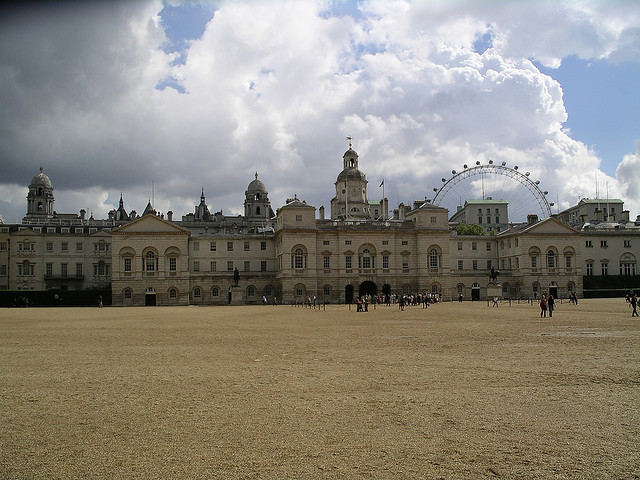
There is certainly no discretion at the entrance to Horse Guards, with its famous mounted sentries outside the gate attracting more photographic attention than Lady GaGa's meat dress. The second Horse Guards building on this site, this version dates from the mid-eighteenth century and attracts a hell of a queue on Open House weekend. After an hour of being entertained with historical anecdotes and explanations of the Trooping of the Colour, which takes place on the parade ground behind Horse Guards on the Queen's official birthday, expectations were high. And although the site's history and royal connections make it an interesting sight to visit, our sneak peek wasn't as enlightening as it could have been, possibly due to the guide's shaky grasp of some of the facts.
Rear view of Horse Guards and parade ground

Thanks to the introductory historical video and fact sheet, we learned that Horse Guards Parade had originally been a tiltyard used for jousting, commissioned by pleasure-loving Henry VIII. The military association began in 1641 under King Charles I, who installed guards on the site to protect his belongings during the Civil War. His efforts didn't go exactly to plan: a few years later he was executed close to Horse Guards, and both of the building's exterior clock faces now bear a black mark at 2 o'clock - the time of his death. The original Horse Guards building was constructed during the reign of Charles II, who set up the Household Cavalry and the Grenadier and Coldstream Guards. Horse Guards became the first standing army barracks, which strongly resembled the current building. The sentries were installed to guard Whitehall Palace opposite, but when it was almost completely destroyed by fire in 1698, the Royal Court moved to St James's Palace behind Horse Guards - but the sentries stayed where they were. After falling into disrepair through overcrowding, the original Horse Guards was demolished and a new, larger building was unveiled in the 1750s. Nowadays, Horse Guards is the administrative headquarters of London District, responsible for all regular and Territorial Army units in Greater London. Horse Guards also serves as home to Headquarters Household Division (responsible for organising ceremonial occasions) and the Regimental Headquarters of the Household Cavalry.

After talking us through a few historical anecdotes and the artworks on the wall, our guide led us into the second and final room of the 45 minute visit: the office of the Major-General Commanding the Household Division and the General Officer Commanding London District. More interestingly, it was once occupied by the Duke of Wellington, whose valuable desk remains in use. The room is also used by 'lesser' royals such as the princes as a viewing platform during the Trooping of the Colour.
Although interesting to learn more about a site that has such long connections with England's rulers, the visit wasn't as in-depth or inspiring as I was hoping after the hour's wait.

Foreign and Commonwealth Office


Following the unexpected disappointment of the day came its unexpected gem: the Foreign Office, which I only chose to visit as I was around the corner and there was no queue. decision was immediately vindicated on stepping into the grand courtyard: this was no ordinary office building.
Formerly located in nearby Downing and Fludyer Streets, the Foreign Office has occupied this building on King Charles Street since1868. At this time, it was also home to the India Office. During the mid-twentieth century it fell into disrepair through overcowding, and a 13 year refurbishment programme began in 1984, revealing some hidden architectural features and beautiful decorations in the process. Beginning in the old India Office (now used by the FCO), the tour of the sumptuous offices led us through to the stunning Durbar Court, the masterpiece of architect Matthew Digby Wyatt. Its upper levels are graced by statuettes of key figures in Anglo-Indian history, who survey events in the covered courtyard. The sense of elegance was so strong I could almost imagine glamorous nineteeth-century society folk taking a turn about the room, glasses of white wine in hand (the taking of red wine in the courtyard is prohibited, lucky I will probably never receive an invitation).


The Muses staircase was another architectural delight; around an octagonal glass lantern cluster pairs of sculpted cherubs representing the Roman virtues. But the grandest part of the building was the Locarno suite: three rooms originally designed for diplomatic dinners, conferences and receptions. One of the main areas to suffer in the early twentieth century, the rooms have been restored to their original grandeur after the plasterboard covering the original Victorian stencilling on the walls and the conference room's coffered ceiling was stripped away. A small exhibition showed the jaw-dropping transformation from a dingy, uninviting area to the most captivating portion of the building.


The point of departure was down the Grand Staircase, which architect George Gilbert Scott designed as a testemanent to his belief that the FCO was 'a kind of national palace, or drawing room for the nation'. This set of stairs no doubt created the right impression on foreign visitors, with its marble and chrome details and the central dome featuring female figures representing the countries which had diplomatic relations with Great Britan in the 1960s. For me, it was an appropriate conclusion to the surprise 'hit' visit of Open House weekend.


Portcullis House


Opposite Westminster Abbey sits Portcullis House, the 2001 building which provides work space and facilities to the members of  both the House of Parliament and the House of Lords. Its central atrium, a rainforest-eque space with live trees and 'calming' water features, is a key meeting point for MPs, who use it to talk with consitituents, guests and staff. The 2001 building designed by Hopkins Architects gives the Houses of Parliament the extra office space it needed, as well as providing meeting rooms which are used by the Select Committees. The first floor meeting rooms were open to guests, but the personal highlight for me was a photographic exhibition of the 2010 election candidates canvassing in their constituencies. The snapshot of Gordon Brown in Rochdale featured the former PM and his entourage standing behind a wooden gate, around which were crowded a few locals: recognisable among them was the famous 'bigoted woman', as Brown later called her, not realising his microphone was still on.

Six hours after entering City Hall, my curiosity to see the office space of some of the country's most powerful figures was satisfied, and I was exhausted. Open House is a great opportunity to explore famous London landmarks normally off-limits to the public, as well as architecturally interesting private homes and many other buildings. Its programme of events is impressively vast, and taxing on the feet. Next year, I'll choose some more appropriate footwear.

Saturday, 18 September 2010

Open House weekend: Inside the City

For one weekend every September, London buildings of architectural note which are (mostly) normally off-limits to the public open their doors. Open House London first began in 1992, and has expanded its repertoire of sights over the years, with visitors able to explore everything from eco-friendly private homes to town halls to theatres all over Greater London - for free.

After learning about the history and architecture of the City of London on Context's Portrait of a City walk a couple of week's ago, I decided to return to the area and take this opportunity to actually go inside some of the buildings we discussed in detail. Starting at Guildhall Art Gallery (normally £2.50; free on Friday), I skipped through the dull-looking collection of Victorian paintings (lots of twee ladies looking ready to faint from too-tight corsets) and made my way down to the basement, where the remains of a Roman amphitheatre uncovered in 1988 hide. Left behind is some of the walkway graced by Russell Crowe's predecessors and the remains of stone walls which supported the timber seating for spectators: more than 5000 at a time, experts believe. A small exhibition explains more about the games that took place in Roman amphitheatres, London in Roman times and the excavations that uncovered the amphitheatre.

Lloyd's Building
Deciding not to join the painfully slow queue to visit the financial palace that is the Bank of England, I opted instead to venture inside the Richard Rogers-designed Lloyd's Building. Opened in 1986, the building was certainly a radical move for such a British institution as Lloyd's; it being one of Rogers' creations that follows his usual aesthetic of locating all the 'workings' of the building, such as pipes and lifts, on the outside. When I first came face to face with the building on the Context walk, it put me in mind of a scaled-down, smartened-up version of the Puleva dairy products factory I used to pass on the bus from my former home in scenic Alcala de Guadaira to Seville. Open to the public on just one day each year, a view of the inside was definitely worth queuing for though: a surprising combination of post-modern and traditional not at all reminiscent of a dairy factory.

View from 'The Room'

The Open House self-guided visit began in 'The Room', an open-plan office space on the first floor where Lloyd's underwriters huddle together on cramped workstations. Contrasting with the modern workspaces are the ornate wooden clock which dominates one end of the room, and the mahogany rostrum which came from the 1928 Lloyd's building. Hanging inside the pillared structure of the rostrum is the Lutine Bell, traditionally rung to alert staff to important news (so much more elegant than a round robin email); one stroke signalling bad tidings, two for glad. The bell was on board the HMS Lutine when she sank with her cargo of gold and silver bullion in 1799. As Lloyd's had insured this valuable freight (worth over £1 million) and paid the claim in full, the business got to keep the bell.


Following a perusal of The Room, visitors were whisked up to the eleventh floor in one of the exterior glass lifts; the first of their kind in Britain. As we shot upwards, a child standing by the window promptly declared 'I don't like it. I'm scared', and I have to say I agreed: once we stepped out of the lift, the glass-sided walkway linking the lifts to the main building may have afforded impressive views over the City, but it made my head spin and my legs wobble. Fotunately a head for heights wasn't quite so necessary inside 'Gallery 11', unless visitors chose to peer over the balustrade and down the central atrium for a view of The Room. On this level, the style of the building changed abruptly at the doorway to the Adam Room, an eighteenth century dining room designed by Robert Adam for the Earl of Shelbourne. The stucco-clad, chandelier-illuminated room was bought whole at auction by Lloyd's in 1958, later moving to the new building. Also providing a sense of history in Gallery 11 is the collection of Terrence Cuneo paintings which depict different scenes from the two previous Lloyd's buildings.

As the glass lift swept downwards, I momentarily forgot my fear of heights at the sight of the view before us: Tower Bridge, the London Eye and St Paul's were all visible on London's skyline. I began to see the point of Rogers' design technique: a lift with a view like this is surely superior to an enclosed box where the only sights to behold are your fellow lift passengers. Can't say I'd like to be in one if it broke down though.

Exiting the building, I wandered through Victorian Leadenhall Market, unfortunately under scaffolding for restoration works, but open to the public during Open House, with live music and food and drink stalls on site this weekend. Unfortunately, I had run out of time to see more venues, but tomorrow morning I'll be setting the alarm clock and getting back out there to see some more of what Open House has to offer.


Leadenhall Market (minus scaffolding)


  • Open House is taking place in London on 18 and 19 September. Details of buildings open to the public can be found here.

Friday, 17 September 2010

Lizzie Mary Cullen goes solo at Artefact


One thing I'm particularly enjoying about London is its vibrant events calendar. Every day Twitter bombards me with details of theatre performances, exhibitions, farmers' markets, food festivals and more listings than I even have time to read, let alone attend. But in these listings, it's often the big events that stand out - the ones with the PR power behind them. Smaller or more low-key happenings in the capital can be difficult to discover through the usual channels such as Time Out or the print media. So, when details of Lizzie Mary Cullen's first solo show at Artefact: The Framers' Gallery kept popping up on Facebook, I thought I'd steer my crash course in getting to know London away from the main monuments for the afternoon.

A multi-award winner aged just 24, talented Cullen's work has been featured in Design Week and Blueprint and exhibited internationally. The London-based designer chose her current hometown as the location of her first solo show (in aid of The Big Issue), bringing Artefact: The Framers' Gallery to life until 25 September with her eye-catching cityscapes and some playful murals penned directly onto the gallery's walls. And with Daniel Radcliffe in attendance on opening night and a commission to enliven the walls of Italian restaurant Zizzi under her belt, Cullen's exhibition seemed well worth checking out.


Now, I'm not exactly what you'd call an art buff: I enjoy visiting galleries if the works on the wall catch my imagination, but I certainly can't spend a whole day in one (as those who recall my half hour visit to the Guggenheim will know). Fortunately for me, the petite Framers' Gallery definitely didn't require hours of perusal. Around 30 of Cullen's works are currently hanging on their walls - just enough to keep me occupied for a while, and to leave me wanting more.


Cullen's psychogeographical drawings of London and New York feature recognisable monuments and scenes transformed into almost fantastical representations, drawing the viewer's eye into her swirly designs. In addition to buildings and areas we all know, such as the Royal Exchange and Canary Wharf, Cullen's black and white designs also bring to life areas such as Peckham and New Cross Gate, presumably drawn when she was studying at Goldsmiths. Also present was a captivating drawing of the 453 bus route: apparently Cullen likes to sit on the top deck of London buses and sketch what she sees, transforming it into her psychogeographical style. A particular favourite of mine was the one colour drawing, of a fantastical cycle ride through London, with details of the story behind it inscribed in the bottom right-hand corner. Her designs animate the city, showing it from a fresh perspective and inviting even the most casual observer into the landscape to explore.


  • Lizzie Mary Cullen's solo show is on at Artefact: The Framer's Gallery (36 Windmill Street, London W1 2JT) until 25 September. Nearest tube: Goodge Street.